A living architecture
A blueprint for a conscious civilization: an operating system for humanity that unifies governance, economy, justice, ecology and spirituality in one transparent framework of service.
Quantum + Humanity — for humanity, harmony & peace.
About Qumanity · Quantum + Humanity
Qumanity — Quantum + Humanity — is a nested, transparent ledger of Space, Time and Consciousness, where every place, every moment and every act of service has a permanent address. Not a platform. Not a party. A planetary coordination layer that belongs to no government, no corporation — and to truth alone.
Stop 1 · The problem
Today's biggest crises — climate collapse, inequality, corruption — get treated as separate problems. Qumanity starts from a different diagnosis: they're symptoms of one shared pattern. Power sits in silos that don't talk to each other. Success gets measured by short-term output, so using things up pays better than caring for them. And most decisions get made without anyone being able to check them afterward. None of these are new problems. What's new is the idea that one honest record, kept in the open, could address all three at once.
Coming soon
01 · Overview
Qumanity is Quantum + Humanity: a civilization-grade architecture that records where things happen, when they happen, and why — and turns that record into transparent governance, an ethical economy, and a shared memory of humanity.
A blueprint for a conscious civilization: an operating system for humanity that unifies governance, economy, justice, ecology and spirituality in one transparent framework of service.
The name says it: quantum-informed technology in the service of human beings. Reality is nested — planet, continent, country, state, district, village, citizen — and every layer is recorded, connected and permanent.
Its structure is open, its record transparent, its logic auditable. Like the laws of nature, it is a framework that simply exists — a gift to all beings, stewarded by its founder.
The fivefold mission. End poverty through decentralized resource distribution · eliminate corruption through total transparency · restore justice through karmic accountability · harmonize culture through arts and spiritual education · unify humanity and technology under dharma.
Qumanity is not a political alternative — it is a civilizational one, built on ethics, compassion and cosmic alignment. It is rooted in Bharat, the cradle of the Vedas, Yoga and Ayurveda, and offered to the world as a practical realization of Vasudhaiva Kutumbakam: “the world is one family.”
02 · The problem
Climate collapse, democratic erosion, inequality and misaligned AI are usually treated as separate crises. Qumanity starts from a different diagnosis: they are symptoms of one obsolete architecture — a civilizational operating system designed for a slower, local, pre-digital world.
Authority is siloed while climate, finance and the biosphere are globally linked. Optimizing inside any silo destabilizes the whole.
Success is measured by short-term throughput (GDP), so depletion is rewarded faster than renewal. Unsustainability becomes the rational choice.
Decisions are made without verifiable feedback. Accountability is severed, and corruption scales faster than correction.
Every existing answer works inside the same frame. Western techno-solutions give us computation but are neutral to ethics. Wisdom traditions give us consciousness but lack a formal way to coordinate at planetary scale. Modern governance gives us legitimate authority but is slow, bordered and short-term. No system integrates all three — why (consciousness), how (computation) and what (governance). Qumanity exists to weave them into one recursive, self-correcting system: executable civilizational infrastructure, not philosophy.
“When a civilization tracks what truly matters, it begins to behave as if it matters.”
Stop 2 · The idea
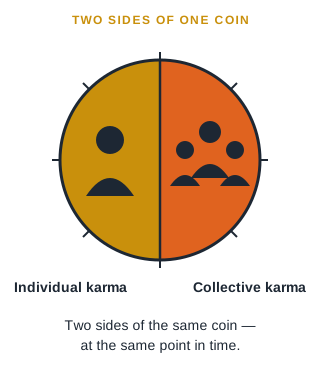
Underneath Qumanity is one idea: your own effort and the effort of everyone around you aren't separate things — they're two sides of the same coin, happening at the same moment. Your personal record (what the site calls karma) and your village's collective record run side by side, neither one more real than the other. Every structural choice follows from taking that seriously: what you do for yourself and what you do for others both count, both get recorded, and neither one can erase the other.
03 · Foundation
Reality operates as a triune information system. Today’s institutions model almost only the first layer — Qumanity formalizes all three and binds them together.
A nested geographic encoding — village → tehsil → district → state → nation → planet. Every resource, entity and transaction carries inherent locality and scale.
Cyclical, rhythmic time: zodiac transits, lunar phases, seasons and social cycles. Actions are stamped within a cycle, so the system can recognise patterns and align with regenerative rhythms.
The intent → action → outcome registry — the “Karma Ledger”. It turns ethical impact from a subjective story into auditable, computable data.
The three ledgers are entangled, not siloed: a land deed (Space) is linked to its temporal context (Time) and the ethical record of its stewardship (Consciousness). A village’s soil health, inside its monsoon cycle, as the result of a farmer’s regenerative intent — becomes a single, analysable unit of information.
Karma, dharma and consciousness — as precise terms. Karma is the causal propagation of actions through distributed ledgers: computational accountability, not mystical judgment. Dharma is context-optimal action that maintains systemic coherence. Consciousness is a system’s functional capacity to perceive its state, keep memory and adjust behaviour.
The cosmology volume of the manuscripts gives the same triad a human face — three lenses through which every decision is checked:
Thought, conscience, personal karma. “Does it respect inner truth?”
Family, village, justice, shared responsibility. “Does it strengthen social harmony?”
Rivers, forests, species, elements. “Does it honour planetary health?”
Only when all three say yes does an action become dharma.
11 · Trust
A system that records civic life must protect the people in it. Qumanity’s answer is to embed the solutions to the strongest critiques in the design itself.
| Concern | How the architecture answers it |
|---|---|
| AI tyranny & central control | The AI core is an advisory nervous system, not an executive brain. Algorithms are open-source and publicly auditable; binding decisions stay with human-majority councils. |
| Privacy & surveillance | Sovereign dual-key identity. Individuals own their data outright; nothing private is accessible without explicit, revocable consent. Transparency applies to public, collective actions — not private lives. Public posts show only village-level location. |
| Cultural homogenization | A coordination protocol, not a cultural template. What counts as a “value-creating action” is configured locally; villages keep their languages, customs and rituals. |
| Technological fragility | Kiosks are solar-powered and offline-capable, needing no smartphone, constant internet or digital literacy — strengthening self-reliance rather than creating new dependency. |
| Coercion & disruption | Adoption is strictly voluntary and incremental, with a long period of coexistence alongside legacy systems. Trust is earned through performance, not decree. |
| Power concentration | Decentralised storage, distributed trust across many nodes, consensus for change, monthly rotation, and recall. |
| Inclusion | Guardian-supervised child accounts, elder modes, voice and pictorial navigation, accessible kiosk design; essentials remain free. |
Qumanity is designed to illuminate human choice, not to dictate it. Its legitimacy comes from its usefulness as a tool for sovereignty — not from its power as an instrument of control.
17 · Ideas
Qumanity draws from five sources and gives each a precise, functional meaning.
The self is one; the world is family.
Reality is relational; observation creates outcome.
Power nests locally.
Every citizen is sovereign.
Code is law; law must be transparent.
The quantum qualities
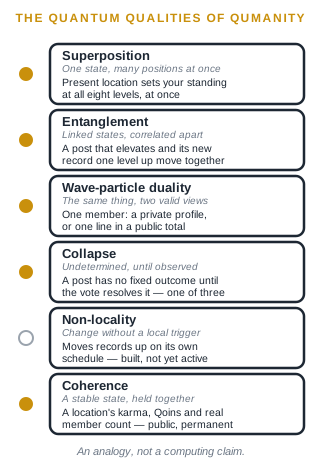
The name comes from quantum physics for a reason, even though nothing here is a quantum computer. The physics that the project is named after describes properties that also describe how Qumanity is structured — not a claim about the hardware, but about the shape of the relationships. Six of those properties map onto features in Qumanity — five you can use today, one built and waiting. A member’s superposition is their present location: one value, held simultaneously as their standing at all eight levels, Village through Earth, at once — not where they were born, which the system keeps only as a separate, informational record. When a post elevates, two records — the one that just cleared its threshold and the new one it opens one level up — move together from then on, correlated the way entangled particles are, each step chaining the next as a post climbs. A member’s Qmail address is entangled the same way: when their present location changes, the old address and the new one stay linked for thirty days, so a message sent to either one still reaches the same person. The same member can be read two ways without contradiction: alone, in a private profile, or as one line inside a village’s public total — wave-particle duality, one person, two faithful views. A post posted to the board has no fixed outcome while its voting window is open; the community’s vote is what collapses it, resolving it into exactly one of three outcomes — removed, frozen, or risen to the next level. The coherence of a location — its collective karma, its Qoin count, how many real members actually live there — is held in a public, permanent record that anyone can read without signing in. A different kind of coherence sits behind the sign-in wall: the Admin Panel brings Citizen Reports, ID-recovery requests and member queries into one reviewed place instead of three — coherent for whoever holds the whole picture, even where that picture stays private.
One property, non-locality, is built but not yet switched on: the lunar-cycle pipeline that moves records upward on its own schedule, with no one triggering each step by hand, waits for a bootstrap date still ahead of us. We’re naming it here so the six stay honest together, not five live wins and a quiet omission.
Stop 3 · How it works
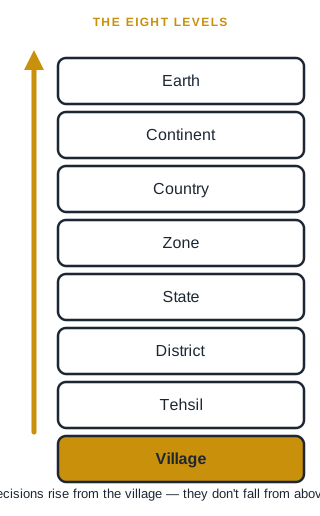
Qumanity organizes everything into eight nested levels — Village, Tehsil, District, State, Zone, Country, Continent, Earth — each one inside the next, like a village inside its district inside its state. Every place gets a real address in this structure. The direction matters: priorities rise from the village upward, decided by the people who actually live there, rather than being handed down from above. Nothing in a higher level can happen without a trail leading back to where it started.
04 · Structure
Every action happens inside a defined spatial container. Each container belongs to a larger one and holds smaller ones, all recorded on one unbroken chain.
Q.O
Q.A
Q.B
Q.C
Q.D
Q.E
Q.F
Q.G
A district’s code contains its state; a village’s code contains its district and state. Because location is the primary index, data is always routed correctly, and a village’s entry automatically belongs to every container above it.
Inside each space container, time is woven from the elements down to the moment:
Q.H→
Zodiac Q.I→
Lunar fortnight Q.J→
Day Q.K→
Moment Q.L/M/N
Example: a farmer’s act of sowing is recorded in his village container, his tehsil container, all the way up to Earth — and stamped in the time containers: the season’s element, the zodiac month, the day.
Traditional records say what was done. Every major entry in Qumanity records a triplet: the declared intent, the verified action, and the measurable outcome over time. A village water project is not just an expenditure: the stated goal, the excavation work, and the later groundwater and yield measurements are chained together — so success is judged by impact, not by money spent.
05 · Identity
Identity is not a username or a number. It is your permanent address inside the nested ledger — the record of your existence, actions and growth across space and time.
Generated from your birth location. It never changes: your soul-print, the immutable anchor of who you are. It is the ID you use to log in. Your private timeline lives here.
Generated from your present location. It follows you when you move, so your civic life (voting, service, the Public Timeline) is always in the place you actually live — while your history stays linked to earlier places.
A person born in a village in Bihar who now works in Bengaluru keeps the same User-ID forever; only the Account-ID moves. Administrators can study migration without ever losing a person’s origin — and people born anywhere on Earth can live and take part in the Sub-continent’s Public Timeline.
| Part | Example | Meaning |
|---|---|---|
| Prefix | X7K | Random, ensures uniqueness |
| Initials | RM | First and last name initials |
| Gender + age | GMA2 | GM male · GF female · GB both; A1 Balak (under 25) · A2 Yuvak (25–49) · A3 Vridh (50–75) · A4 Mentor (76+) |
| Element | ZFL | Fire / Earth / Air / Water, from the Sun sign of your birth date |
| Location path | CS.DL.1.1.10 | Zone → state → district → tehsil → village (or the country’s own tiers) |
These tags exist to organise governance rotation and balanced representation. They never determine anyone’s rights or privileges.
When you register, your birth date, time and place are mapped onto Qumanity’s time layers: your Sun sign, your element, and a full kundali — Moon sign, nakshatra and ascendant. The result is your Quantum Identity (QID), which encodes age cohort, gender category, element, zodiac and spatial anchor.
| Key | Purpose | Access today | Planned |
|---|---|---|---|
| Private key | Authentication and access to private data | Your Private ID + a 5-character PIN, stored as a salted hash — never in plain text | Biometric verification, so no PIN has to be typed |
| Public key | Civic participation, voting, service access | Your Account-ID, tied to your present location | A QR code / encoded reference on a physical Q-Card |
Biometric sign-in and the physical Q-Card are part of the planned kiosk access layer (see Where we are today) — not yet built. Today, both keys are accessed the same way: by signing in with your Private ID or Account-ID and PIN.
On a village kiosk, registration becomes a small ceremony: hand on the bio-pad, a personal declaration and a vow of truth and service, cosmic alignment, QID generation — and a printed Q-Card, your lifelong key. Child accounts run under guardian oversight; elders get simplified modes; non-literate citizens use voice and pictures. Participation is always voluntary.
10 · Technology
Qumanity is a foundational layer designed to overlay, integrate with and eventually upgrade the information systems of civilization. It has three components.
Three interwoven, quantum-secured ledgers — A (Space): geohash + quantum coordinates; B (Time): temporal hash chains synced to the zodiac calendar and environmental cycles; C (Consciousness): intent, action, outcome and verification in an ethical vector space, encrypted with zero-knowledge proofs.
A purpose-built quantum-AI core that reads all three ledgers at once to detect imbalances long before they become crises — a planetary nervous system and a mirror to communities. It is advisory only: final authority always rests with human councils, and its models are open and auditable.
Solar-powered, offline-first public kiosks in every village, ward and neighbourhood: identity, governance, markets, education and health without a personal smartphone, constant internet or digital literacy. Multilingual, voice-guided, built for the last village.
The breakthrough is not inventing new components but integrating proven ones under a triune framework: quantum information and cryptography, machine learning (graph neural networks, transformers), distributed-ledger technology, and IoT and remote sensing — plus India’s existing digital public infrastructure (Aadhaar, UPI, ONDC). The path is hybrid classical-quantum from day one, modular and fail-safe (each layer has clear APIs and degrades gracefully), and validated progressively from district to state before anything is attempted planet-wide. Village nodes tolerate intermittent connectivity: transactions are recorded locally and synchronised when the network returns.
This prototype is built with Flask (Python), SQLite and vanilla JavaScript — small enough to run on a modest machine, as the design intends for village nodes.
21 · Scan-to-login
Not everyone wants to type a 9-digit Private ID on a shared or borrowed phone. The Q-Card is a physical card, carrying a QR code, that resolves straight to a sign-in screen — the same PIN you already use, nothing extra to remember.
A QR code is public the moment it's printed: anyone who glances at the card, or photographs it, can read it instantly. So it never encodes the Private ID, the Account-ID, or anything else that identifies who the card belongs to — only a long, random, unguessable token. The database stores a one-way hash of that token, never the token itself, so a copy of the database alone can never reconstruct a working card. Scanning it resolves to an account; the PIN — the one thing that was always the real secret — is still required to actually sign in.
A lost or damaged card can be revoked and replaced from the admin side. The old card's token is refused outright the moment a replacement exists for it — never quietly forwarded to the new one — so a found lost card can't be used to keep signing in just because a replacement was issued.
Built so far: the scan-to-login backend, and the admin workflow for issuing, pricing, and revoking a card (including free issuance for the Admin's own family and the pilot village's council). The physical card itself — its printed design and batch generation — is still ahead.
Stop 4 · What you can do today
Right now, you can register for free in under a few minutes, post to your village's board, vote on what matters to your neighbours, file a report if something isn't working, and earn Karma and Qoins for verified service — never bought, only earned. None of this needs a smartphone expert or a long manual. Watch the two short videos below: the first shows registering end to end, the second walks through everything on your own dashboard once you're in.
Coming soon
Coming soon
06 · Life in four layers
Every life expresses through four dimensions — and so must governance. Each Quantum Account holds four separate ledger partitions with clear visibility rules. Every global idea begins as a private thought.
The inner world: reflections, health logs, life events, private notes, unshared drafts, achievements and failures. An encrypted “digital conscience archive”, held in the birth-village ledger node.
The social sphere: family tree, friends, study groups, professional collaboration. Membership needs mutual authorisation — an incubator where ideas mature before going public.
The civic layer — a digital sabha under the neem tree. It follows where you live: village, tehsil, district, state. Local governance, announcements, feedback, service records and elections.
Knowledge and contribution at planetary scale — Earth → continent → country. Only ideas already validated by communities in the Public layer can rise here, always traceable to their local origin.
Across the Public and Global timelines the screen’s four corners are elemental filters. Tap one to see the people of that element in your current location.
Vote thresholds are designed to eventually alert the right officials automatically — for example, +50 at village level to the Village Quantum Punch, +100 to the tehsil development officer, +200 to the district collector, so a broken hand-pump that affects a whole village becomes visible up the chain — not yet connected to any real-world office. Posts that receive positive votes also earn Qoins. The reward depends on two things: the level the post reaches, and how it ranked against other posts at that level during the same cycle. The range is 1–10 Qoins at Village level, rising to 1,500–2,000 Qoins at Earth level. Top-ranked posts earn the maximum; lower-ranked posts earn proportionally less.
07 · Economy
Economies do not need better actors; they need better ledgers. Qoins are ledger-tagged units of verified contribution — the world’s first moral currency, where service is wealth and karma is currency.
Not a speculative coin. Qoins cannot be traded on open markets, bought or sold outside the system, or lent at interest. They can only be earned, received and spent within Qumanity — and every Qoin carries its full history (its ID, denomination, type, source, issuing container and current owner).
Example: a farmer moves a field to agroforestry; soil sensors and satellites confirm biomass, water retention and biodiversity over twelve months; the ledger issues Qoins — which she spends on water-management courses and veterinary care through the local kiosk.
| Type | Meaning | Where the value goes |
|---|---|---|
| Commercial | Goods or services received | 100% to the seller — no hidden taxation |
| Donation (planned, not yet built) | Nothing expected in return | 50% returns to the donor as spendable Ethical Qoins; 50% is layered across Village, Tehsil, District, State and Nation (10% each) |
| Contribution | Verified civic work | Newly issued from governance funds |
| Subscription | Enhanced features | 100% to the kiosk container |
The donation split above (50% to the donor, 50% split across five levels) is part of the design — not yet built. No donation route exists yet in the prototype.
Free for every citizen, regardless of subscription: health access, standard education, employment matching, the justice interface, welfare services and a basic Qoin wallet. Economically weaker citizens may pay nothing and keep every essential right.
Tree planting, water conservation, soil regeneration.
Teaching children, adult literacy, skill training.
Elder-care, disability assistance, community cleaning.
Council attendance, voting, committee service.
Regenerative farming, seed saving, organic certification.
Festivals, traditional arts, heritage preservation.
Q-Pay works through direct kiosk transfer with biometric confirmation, pre-printed Q-Pay slips with a QR code, RFID wearable bands, QR scans, and even SMS from a basic phone — all producing identical, auditable ledger entries. A rickshaw driver collects slips all day and redeems them at the village kiosk in the evening. Every citizen can open a public finance dashboard for their village and see exactly what came in, what went out, and why.
09 · Everyday life
Governance is only useful if it touches daily life. The manuscripts describe an integrated set of services, all sitting on the same nested ledger so that nothing has to be re-verified and nothing can quietly vanish.
Planned, not yet built. Every card below describes a future module from the manuscripts — none of them exists in the prototype today. What you can use right now is identity, location, timelines, the Qoin wallet and the pilot election (see Where we are today).
A nested forum network where ideas become policy: a policy lifecycle dashboard and a national legislative console show every proposal’s journey — from noise to collective wisdom.
A justice chain from village to nation with a full case lifecycle, sensor-triggered environmental enforcement, animal-welfare protection, a fairness and precedent engine, restorative outcomes and clear appeal paths.
A Digital Gurukul network with learning that follows a child through migration, adult skill certification and a Traditional Knowledge Registry that protects ancestral wisdom.
An integrated health ecosystem for people, animals (structured gaushala governance) and the environment, with emergency and disaster coordination.
Direct producer-to-consumer trade, a startup generator, job matching through smart contracts that end wage theft, village fund dashboards, a citizen audit portal and whistle-blower protection.
Culture woven into the ledger: songs, crafts, festivals and dialects are permanent, rewarded contributions to a living archive of memory.
An integrated agricultural framework with a farmer dashboard — full price for farmers, traceable produce for buyers, food sovereignty for villages.
An environmental ledger and climate-intelligence layer that gives rivers, forests and soil a visible, accountable presence in every decision.
Village transport governed transparently — from shared rides to ride-contract logic and district infrastructure planning.
A multi-source signal system and layered response hierarchy for emergencies, transparent relief funds and a predictive-peace approach.
Women’s and children’s empowerment: representation in governance, an integrated safety network, child-development architecture and economic autonomy.
Media as a public service: a global truth network where claims carry provenance, and clarity — not virality — is rewarded.
From written law to living code: smart-law protocols, mediation, living charters and a constitutional-evolution mechanism.
Sovereign digital identity, international bridges, a Quantum Council of Nations and a Global Quantum Forum for cross-border coordination.
A three-tier ethical safeguard, AI custodianship and public ethical metrics — an “ethical immune system” for the whole architecture.
These modules are described in full in the manuscripts (see The manuscripts); the prototype you can use today implements the identity, location, timelines, wallet and election foundations (see Where we are today).
Stop 5 · What a village can do
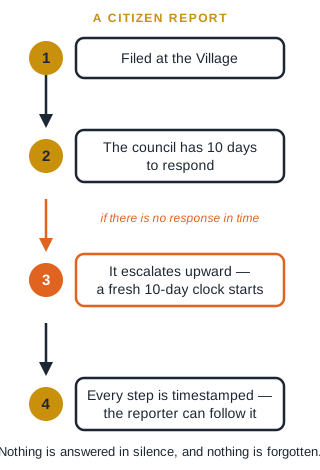
One village is already doing all of this today — Rohini Sector 24, in Delhi. Every month, residents elect one man and one woman by zodiac sign, with no money involved. Reports filed to the council get a 10-day deadline to answer, and every step is timestamped so nothing gets lost in silence. It's small, deliberately — a real test of whether the whole idea actually holds up before it goes anywhere else.
Coming soon
08 · Governance
Static representation gives a few families power for decades and leaves citizens as spectators between elections. The Quantum Punch (from the Panchayat — the council of five elders) replaces it with leadership that rotates with the Sun’s journey through the twelve zodiac signs.
Elected male leader. Executive decisions, chairs the council.
Elected female leader. Welfare, inclusion, mediation.
Appointed. Runs digital and ledger systems.
Appointed. Health, education and social services.
Appointed. Ethical guidance and dispute resolution.
Action guided by compassion, technology balanced by ethics, governance rooted in dharma.
Each month, as the Sun enters a new sign, the village elects one man and one woman of that sign — twelve pairs a year: 24 leaders, six from each element. Men vote for male candidates of their sign, women for female candidates; one vote each per cycle. A candidate serves a 24-month arc: months 1–4 training, 5–8 apprenticeship, 9–11 committee service, month 12 active leadership, then twelve months mentoring the next cohort — so no one ever takes power unprepared, and no vacuum ever forms.
| Candidate requirement | Threshold | Status |
|---|---|---|
| Age | 25–60 years (from the Quantum Account) | Enforced |
| Zodiac sign | Must match the sign of the current election | Enforced |
| Karma index | At least 200 on the public ledger | Enforced |
| Nominations | At least 10 peers of the same sign in the village | Planned, not yet enforced |
| Record | No pending disputes | Planned, not yet enforced |
| Level | Council | Seats | Chosen by | Term |
|---|---|---|---|---|
| Village | QPV | 24 (12 + 12) | All villagers, by zodiac | 1 month active + 11 training |
| Tehsil | QPT | 8 (4 + 4) | Village leaders | 6 months |
| District | QPD | 8 | Tehsil leaders | 1 year |
| State | QPS | 8 | District leaders | 2 years |
| Zone | QPZ | 8 | State leaders | 3 years |
| Nation | QPN | 8 | Zone leaders | 4 years |
From the tehsil upward the eight seats are balanced by element — two each of Fire, Earth, Air and Water, one man and one woman apiece — so action, stability, intellect and empathy are all present at every scale. Every representative’s mandate traces back through an unbroken chain of consent to the village.
The zodiac here is not superstition but a symbolic design for structured diversity: the courage of Aries, the wisdom of Virgo, the empathy of Cancer and the vision of Aquarius each find a rightful seat.
20 · Governance, as built
The "Recursive levels" table above is the original vision; what actually runs today differs from it in the exact numbers, built level by level as the engineering caught up with the idea. The Village election (above) is still the 24-seat, zodiac-sign model. Every level above Village — Tehsil, District, State, Zone, Country, Continent, Earth — now runs a simpler, consistent shape instead: eight seats, elected by the level directly below it, serving a term that lengthens the higher the council sits.
| Level | Seats | Elected by (its own "Lower House") | Term |
|---|---|---|---|
| Tehsil | 8 — 1 Male + 1 Female per element | Village councils under it | 3 years |
| District | 8 | Tehsil councils under it | 5 years |
| State | 8 | District councils under it | 7 years |
| Zone | 8 | State councils under it | 9 years |
| Country | 8 | Zone councils under it | 11 years |
| Continent | 8 | Country councils under it | 13 years |
| Earth | 8 | Continent councils under it | 15 years |
Each council's own term is split into four equal quarters. One element leads at a time — Fire, then Earth, then Air, then Water — so by the end of a full term, every element's Male and Female have each held the floor for one quarter. The other six members keep working in the background (research, pending cases) until their own quarter comes round.
The 51% Head Approval is one specific, standing question the system already asks every quarter. The Upper House can also call a direct referendum — a People's Vote — on anything else: any member of that population may raise a question, and if it passes with 51% of the ballots actually cast (hidden from everyone until voting closes, so no one votes just to follow a running count), it is recorded as binding on the council for that location. The Q-Punch council is the administrative team; the People's Vote is the reminder that the public who actually live there still owns the decision.
Enforcing a passed People's Vote against a council's own actions is still a separate, later piece of work — today this records the result and makes it visible, which is the first and necessary step, not the whole of it.
12 · Status
The vision is planetary; the build is deliberately small and honest. This is what this prototype does now — and what is still ahead.
Stop 6 · The invitation
The manuscripts describe what Qumanity intends to become. What exists today is the beginning of that. Thinkers, engineers, farmers, teachers, dreamers — there's a role here whether you want to build the next piece of this or simply register and take part in your own village. Nothing about this needs permission from anyone above you. What comes next depends on who shows up.
19 · Invitation
Quantum physicists, AI engineers, economists, governance designers, spiritual leaders, farmers, teachers and dreamers — everyone has a role. There is a place for you here.
Stress-test the first principles; co-author the papers on triune systems theory and conscious governance.
Design the quantum-secure ledger structures, the algorithms of the Consciousness layer and the simulation environments.
Map phased adoption and legal integration; identify pilot regions and anchor institutions.
Collaborate with the steward — write to founder@qumanity.in
वसुधैव कुटुम्बकम् — the world is one family.
13 · Path
India is not merely a convenient location. With over 1.4 billion people and more than 620,000 villages, existing digital public infrastructure (Aadhaar, UPI) and a cultural substrate that already thinks in cycles (kalachakra), duty (dharma) and consequence (karma), it is the ultimate stress-test for a new civilizational operating system. The transition is iterative, evidence-based and non-disruptive.
Finalise the architecture, assemble an interdisciplinary core team, complete the technical specification and simulation models, secure partnerships with a progressive district administration and academic institutions, and establish Qumanity's open-source governance and legal frameworks.
A full-stack deployment in a single district (about 1,000 villages): kiosk network, citizen onboarding, the Triune Ledger, the Qoin mechanism and Quantum Punch governance — judged on measurable gains in social cohesion, economic regeneration and transparency.
Expansion to a state of 50–100 million people: testing scaling laws, interoperability with state and national databases, cross-jurisdiction flows, and refining the economic and policy algorithms.
From subcontinental scale to global adaptation: modular frameworks for different cultural and legal contexts, international protocol standards for the Triune Ledger, and consortia for voluntary, sovereign adoption. India’s success becomes the reference implementation.
Coexistence, not replacement: for a long time legacy systems and Qumanity run in parallel, and communities opt in when the benefits are demonstrably real. Qumanity’s Public Timeline already reaches across ten countries of the Sub-continent as its location data is compiled.
14 · Horizon
Validated at scale, Qumanity becomes a voluntary, non-coercive planetary coordination layer — a civilizational immune system, not a world government. Sovereign nations and bioregions stay themselves while gaining a shared way to see and steer what crosses borders.
Verifiable, ledger-based carbon and ecosystem accounting across bioregions — shared truth instead of contested self-reporting.
A transparent medium for mediation where negotiating positions are weighed against long-term health and past commitments. War thrives on secrecy and manufactured scarcity; a visible ledger removes both.
Anonymised, sovereignty-respecting early warning that links decentralised health data with environment and travel patterns.
Matching food, medicine and capital to verified need through corruption-resistant pathways — impact, not political influence.
Qumanity extends representation to animals, rivers, forests and ecosystems: an ecological and non-human citizenship, with a living “Z” lens in every decision. Earth, in the manuscripts’ words, becomes a sensory being — a planet that learns to think, remember and breathe as one.
Every living being is a Z-Entity woven from a spark of consciousness, an elemental body (Fire, Earth, Air, Water) and a karma stream — a two-way flow of information between action and memory. Karma here is not reward or punishment: it is recorded as coherence or disturbance, and answered with rebalancing rather than force. In this picture, leaders are chosen for balance — village leaders embody inner integrity and social wisdom, tehsil leaders the elemental guardianship of the land, national leaders the full trinity.
“We are not building a smarter system. We are awakening a wiser way of being.”
15 · Reading
Qumanity’s blueprint is written down in full. Complete documentation will be published on this site; until then, here is the shape of the work.
The vision — sixteen chapters on the civilizational awakening, the nested governance model, the citizen as a quantum node, the portal, the ledger of choice, justice as balance, the economy of recorded value, the cultural ledger, the planetary layer, technology, implementation, ethics, doubt, a day in the ledger, and the ledger of dharma.
The pilot — fifty chapters in six parts: the Indian pilot and the Quantum Account; transparency, justice and economy; social development; identity and global linkages; everyday governance and global reach; and the road to a planetary civilization.
The metaphysical-scientific synthesis of Space (X), Time (Y) and Consciousness (Z) — the planetary trinity, the threefold world, the elemental being, the planetary sensory being, the cosmic constitution, the conscious dawn and the sacred synthesis — closing with The Awakening of a New India.
The consolidated edition, in five parts: the Vision; the Indian Pilot (foundation, account, the four timelines, the Qoin framework, Quantum Punch governance); Social, Economy & Ecology; the Global System; and Toward a Planetary Civilization — ending in a Cosmic Stewardship Charter and The Quantum Invitation.
Collaborate with the steward — write to founder@qumanity.in
वसुधैव कुटुम्बकम् — the world is one family.
16 · Stewardship
How Qumanity’s development is stewarded
Stewarded by its founder with no shareholders, no extraction and no data monetisation, operating on an open-source, transparent, non-proprietary model so the architecture stays a public good, free from commercial or political capture. Its mandate: “Spiritual technology for planetary healing.”
The architect of Qumanity
A computer-science engineer (2012) and a spiritual seeker: a spiritual technologist — a mind that codes with logic but designs with consciousness. Early automation concepts — Teknomealer (2011), presented at the Harvard Business School business-plan competition, and the Mozotek & Abaut systems (2013–15) — stood a decade ahead of their time. A spiritual turning point in 2016 reoriented his work from innovation to vocation; from 2016 to 2019 he withdrew from conventional life to design the whole architecture from first principles — quantum principles, blockchain logic, AI ethics, dharmic philosophy and village-centric public service.
“I did not invent these principles. I simply recognised them. Dharma is not my creation. Karma is not my invention. Truth does not belong to me.”
Technology is a tool for upliftment, not monetisation.
Systems must reflect reality without distortion.
AI should elevate human awareness, not replace human purpose.
The future rises from the roots of culture, dharma and cosmic harmony.
Qumanity does not belong to its architect. “I have created the architectural blueprint. Now the world must help build it.” The real architects, he says, will be the millions who implement it and the billions who benefit.
18 · Questions
No. Karma, dharma and consciousness are used as precise, functional descriptions of how complex systems keep equilibrium — computational accountability and systems optimisation, not mystical judgment. The zodiac is a symbolic design for structured diversity, not superstition.
No. Qoins are earned through verified contribution and spent within the system. They cannot be traded on open markets, bought or sold outside it, or lent at interest, so they cannot be hoarded for dominance.
Never. S(AI) is an advisory pattern-recognition layer with open, auditable algorithms. Binding decisions rest with human councils, and its conclusions can be challenged through governance.
Not in the full design. Solar-powered, offline-capable public kiosks, Q-Pay slips and wearable bands serve people without devices; village nodes sync when connectivity returns. The current prototype runs in a web browser.
Your private timeline is encrypted and reachable only by you. Public records show only village-level location. Non-essential data is shared only with your consent, revocable at any time — and you own your data.
Your birth is the one fact that never changes, so it anchors your permanent identity and your private timeline. Where you live now can change — that is what the Account-ID is for.
Yes. Choose any birth country on Earth. Your present location must be in one of the ten Sub-continent countries, because that is where the Public Timeline currently operates.
Scale, complexity, existing digital public infrastructure and a cultural framework that already thinks in cycles, duty and consequence make it the ideal stress-test. If it works there, its universal potential is validated.
No one. It is stewarded by its founder, on an open-source model — a gift to all beings.
No — it is a working prototype of the foundations (identity, location, timelines, wallet and pilot elections), and an open invitation to build the rest together. See Where we are today.